

Career and Technical Education:
Construction, Manufacturing, and Transportation

Building & Moving

About the field of Construction, Manufacturing, and Transportation

Background

Construction, Manufacturing, and Transportation Education (formerly Trade & Industry; T&I) prepares individuals for employment in a wide range of industrial occupations, including preparation for apprentice trades, technical occupations, and other industrial and service occupations. Construction, Manufacturing, and Transportation careers include skilled trades and service occupations that involve designing, producing, processing, assembling, maintaining, servicing, or repairing any product or commodity.

Construction, Manufacturing, and Transportation is one of the three original Career and Technical Education (CTE) areas, created in 1917 by the Smith-Hughes legislation. Construction, Manufacturing, and Transportation has evolved in the more than 100 years since its inception from welding and woodworking to include good paying, highly skilled, and sought after careers in manufacturing, engineering, transportation, construction, and supply chain logistics. The student organization for this field, SkillsUSA, was formed in 1965 originally as Vocational Industrial Clubs of America, or VICA. As of 2024, more than 247 districts offer Construction, Manufacturing, and Transportation programs in Minnesota, including 580 teachers and 69,130 students grades 7-12.

The Building and Moving career field on the Minnesota Career Wheel includes three clusters: (a) Construction, (b) Manufacturing, and (c) Supply Chain & Transportation.

Licenses for this career field include:
– Broad-based license for the entire field: does not exist in Minnesota.
– Careers license for the Construction cluster: Construction careers-300100.
– Careers license for the Manufacturing cluster: Manufacturing careers-300200.
– Careers license for the Supply Chain & Transportation cluster: Transportation careers-300700.

– Cross-cutting career-license for the Digital Technology cluster: Communication Technology careers-300000.
– Cross-cutting careers license for the Management & Entrepreneurship cluster: does not exist yet in Minnesota.
– Cross-cutting career-license for the Marketing & Sales cluster: does not exist yet in Minnesota.

Note: These CTE licenses are eligible for Minnesota Department of Education program approval, which affords access to CTE Revenue funding, federal Perkins grants, and more. This is in contrast to the Technology (100100) license, which may have some similar skills and standards as these three licenses, but is not a CTE license and is ineligible for these funding options.


Minnesota is Focused on Building and Moving the Economy

Minnesota’s manufacturing, construction, transportation, and supply chain sectors are the backbone of the state’s economy. Our history of innovation—along with our highly skilled workforce—makes the state a hotbed of industry and manufacturing. Minnesota’s diverse, technology-driven advanced trades and industry sectors are strong in high-tech manufacturing, computers and electronics, medical devices, vehicles, and more.

  • 2nd in Medical Device Manufacturing (Lightcast, 2023)
  • 3rd in Navigational, Measuring, Electromedical, and Control Instruments Manufacturing (Lightcast, 2023)
  • 3rd in Computer Storage Device Manufacturing (Lightcast, 2023)
  • 4th in Technology and Innovation (CNBC, 2023)
  • 6th in Overall Computer and Electronic Product Manufacturing (Lightcast, 2023)
  • 6th in Semiconductors (Business Facilities, 2023)
  • 7th in Technology and Science Workforce (Milken Institute, 2022)
  • 8th Most Innovative State (Yahoo! Finance, 2023)

MN Skilled Trades Companies

  • 3M
  • ACS Group (Civil Engineering)
  • C.H. Robinson (Logistics)
  • Ecolab
  • Fastenal
  • H.B. Fuller (Manufacturing)
  • Polaris
  • Red Wing Shoe
  • Sun Country Airlines
  • Toro

Top in-demand and Construction, Manufacturing, and Transportation


  • Half of all heavy truck driver jobs pay between $49,262 and $66,296 per year, with 4.1% projected growth in job demand during the next ten years.
  • Half of all construction jobs pay between $42,329 and $67,704 per year, with 7.1% projected growth in job demand during the next ten years.
  • Half of all electrician jobs pay between $59,986 and $95,755 per year, with 8.1% projected growth in job demand during the next ten years.
  • Half of all electrical engineering jobs pay between $80,956 and $129,088 per year, with 3.9% projected growth in job demand during the next ten years.

Three Components of Construction, Manufacturing, & Transportation Edu

Courses and Labs

Academic, Rigorous Instruction

Construction, Manufacturing, and Transportation Education prepares students for high wage, high skill, and in demand jobs and careers in construction, manufacturing, transportation, and supply chain logistics. CTE integrates science and math, and even art, ideally while meeting high school graduation requirements and earning college credit and industry certifications. CTE is contextual, combining classroom and laboratory instruction, often making heavy use of project-based learning.

Essential elements include: career awareness, exploration, and preparation; programs of study based on industry; and a balance of classroom and laboratory instruction, which uses technology.

Work-Based Learning

Technical, Relevant Experience

Students learn best by doing. A work-based learning (WBL) project is an extension of the classroom, where students develop specific technical and career knowledge that prepares them for their future. Within Construction, Manufacturing, and Transportation Education, students begin exploring careers of interest, followed by relevant experiences with business and industry, most often through internships or simulated School-Based Enterprises at the school such as a fabrication school operation.

Essential elements include: work-based learning opportunities guided by training agreements and training plans; safety instruction and policies.

Minnesota SkillsUSA

Affective, Relationships/Leadership

SkillsUSA is the Career and Technical Student Organization (CTSO) for Construction, Manufacturing, and Transportation programs and available to students enrolled in a CTE program of study or career cluster. Minnesota SkillsUSA empowers students to become skilled professionals, career-ready leaders, and responsible community members. State membership as of 2022 was more than 750 students in 31 secondary SkillsUSA chapters.

Essential elements include: leadership development opportunities through student organizations or other means.

Career Clusters within Construction, Manufacturing, and Transportation

Construction

Advanced Manufacturing

Supply Chain and Transportation

Example Courses

– Introduction to Construction, Manufacturing, and Transportation
– Career Investigation
– Emerging Technologies
– Technology Innovation and Assessment
– Product Development
– Production Systems
– Drafting
– CAD
– Carpentry
– Building Repair and Maintenance
– Small Engines
– Introduction to Automobiles

– Engineering Essentials
– Introduction to Engineering Design
– Principles of Engineering
– Digital Electronics
– Computer Integrated Manufacturing
– Engineering Design and Development
– Environmental Sustainability
– Civil Engineering and Architecture

– Residential Construction
– Framing Carpentry and Exteriors
– Residential Masonry
– Residential Wiring
– Residential Plumbing
– Residential HVAC
– Commercial Construction
– Welding
– Commercial Masonry
– Commercial Wiring
– Commercial Plumbing
– Civil/Structural Drafting
– Woodworking
– Cabinetry
– Product Development
– Wood Processing/Production
– Simulated School Business

– Welding
– Machining
– Metals Fabrication
– Metal and Wood Processing/Production
– Materials Processing
– Non-Metals Fabrication
– Electro-Mechanical Systems
– Mechatronics
– Robotics
– Engineering Applications
– Power and Energy
– Super Mileage
– Heating, Vent, and Air Conditioning Refrigeration
– Simulated School Business
– Manufacturing Work-Based Learning

– Auto Service, Mechanics, and Repair
– Automatic and Manual Transmission
– Suspension and Steering Brakes
– Electrical/Electronic Systems
– Heating and Air Conditioning
– Engine Performance
– Bicycle, Marine, and Recreational Design and Repair
– Motorcycle Design and Repair
– Hybrid Engines and Super Mileage
– Power Mechanics
– Power, Energy and Transportation
– Auto Body Repair
– Automotive Detailing and Reconditioning
– Diesel Mechanics
– Heavy Equipment Mechanics
– Truck Driving
– Distribution Warehouse Operations
– Aviation
– Basic Pilot Training and Ground School
– Aerospace Technology and Engineering
– Transportation Work-Based Learning

Districts with Construction, Manufacturing, and Transportation Programs

Note: Some districts may by missing if they failed to submit statutorily required data to the state during STAR reporting.
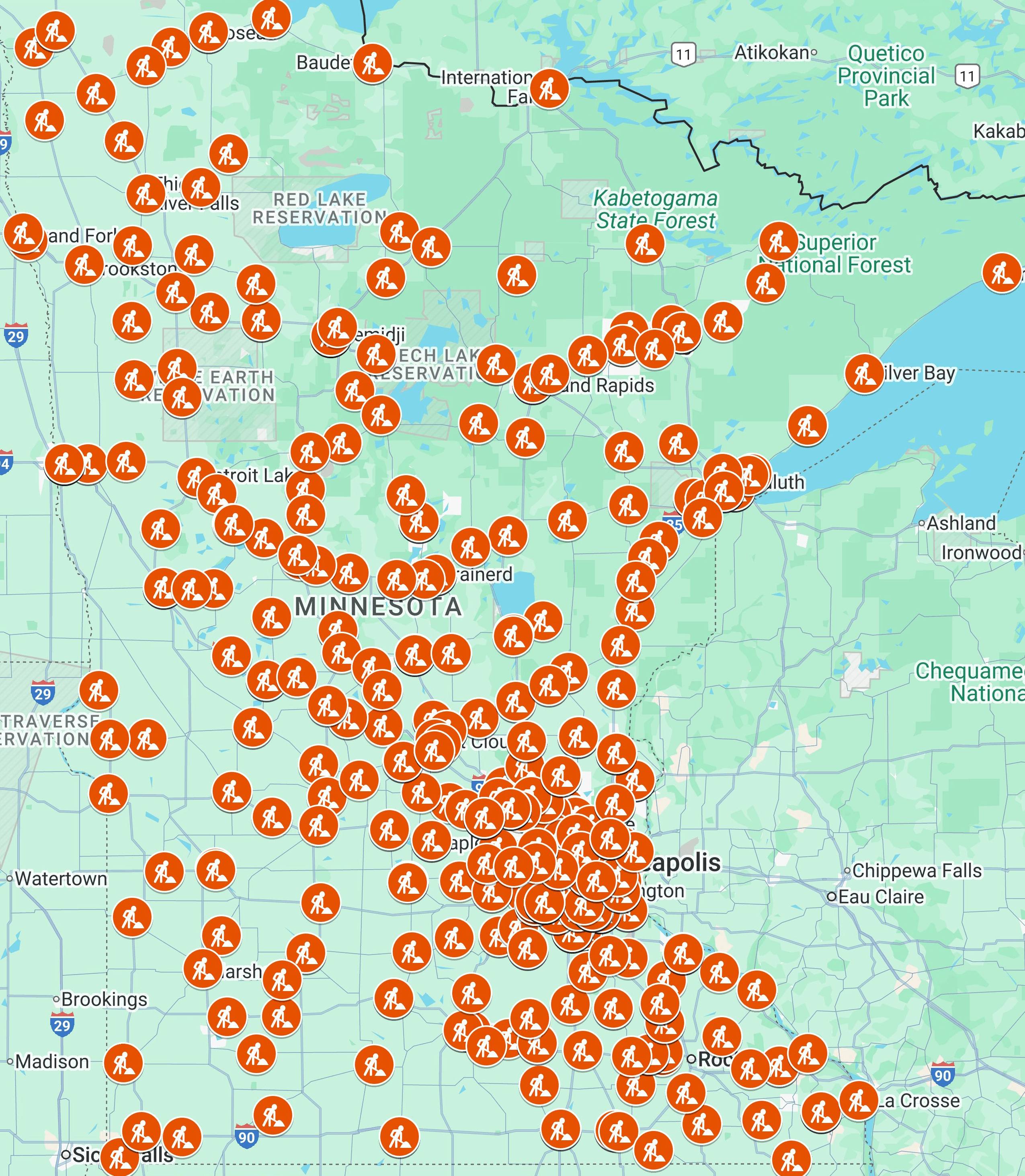
Badger, Bagley, Bemidji, Blackduck, Clearbrook-Gonvick, Crookston, East Grand Forks, Fertile-Beltrami, Fosston, Goodridge, Greenbush-Middle River, Grygla, Kelliher, Kittson Central (Hallock), Lake of the Woods (Baudette), Lancaster, Laporte, Mahnomen, Marshall County Central (Newfolden), Nevis, Norman County East (Twin Valley), Park Rapids, Red Lake County Central (Oklee), Red Lake Falls, Roseau, South Koochiching (Northome), Stephen-Argyle Central, Thief River Falls, Tri-County (Karlstad), Voyageurs Expeditionary (Bemidji), Warroad, Waubun-Ogema-White Earth, and Win-E-Mac (Erskine).

Aitkin, Barnum, Chisholm, Cloquet, Cook County (Grand Marais), Cromwell-Wright, Deer River, Duluth, Ely, Esko, Floodwood, Grand Rapids, Greenway (Coleraine), Hermantown, Hibbing, Hill City, International Falls, Lake Superior (Silver Bay), McGregor, Mesabi East (Aurora), Moose Lake, Mountain Iron-Buhl, Nashwauk-Keewatin, Proctor, Rock Ridge (Virginia), St. Louis County (Iron), and Wrenshall.

Brainerd, Browerville, Cass Lake-Bena, Crosby-Ironton, Freshwater Education District (Wadena), Little Falls, Long Prairie-Grey Eagle, Menahga, Northland, Pequot Lakes, Pierz, Pillager, Pine River-Backus, Sebeka, Staples-Motley, Swanville, Upsala, Verndale, Wadena-Deer Creek, and Walker-Hackensack-Akeley.

Alexandria, Battle Lake, Brandon-Evansville, Chokio-Alberta, Clinton-Graceville-Beardsley, Detroit Lakes, Dilworth-Glyndon-Felton, Fergus Falls, Frazee-Vergas, Hawley, Minnewaska (Glenwood), Moorhead, New York Mills, Osakis, Parkers Prairie, Pelican Rapids, Perham-Dent, Underwood, and Wheaton.

Albany, Annandale, Belgrade-Brooten-Elrosa, Big Lake, Buffalo-Hanover-Montrose, Cambridge-Isanti, Chisago Lakes (Lindstrom), Dassel-Cokato, Delano, East Central (Finlayson), Elk River, Foley, Hinckley-Finlayson, Isle, Kimball, Maple Lake, Melrose, Milaca, Monticello, Mora, North Branch, Ogilvie, Onamia, Paynesville, Pine City, Princeton, ROCORI (Cold Spring), Sartell-St. Stephen, Sauk Centre, Sauk Rapids-Rice, Spectrum (Elk River), St. Cloud, St. Michael-Albertville, Willow River, and Wright Technical Center (Buffalo).

Anoka-Hennepin, Avalon (Saint Paul), Belle Plaine, Bloomington, Burnsville-Eagan-Savage, Career Pathways (Saint Paul), Centennial (Circle Pines), Columbia Heights, Eastern Carver County (Chaska), Eden Prairie, Edina, Farmington, Forest Lake, Fridley, Hastings, Hopkins (Minnetonka), Intermediate 287 (Plymouth), Intermediate 917 (Rosemount), Inver Grove Heights, Jordan, Lakeville, Mahtomedi, Metro Schools Charter (Minneapolis), Minneapolis, Minnesota Math and Science Academy (Saint Paul), Minnetonka, Mounds View (Arden Hills), New Prague, North St. Paul-Maplewood-Oakdale, Northeast Metro 916 (White Bear Lake), Osseo, PACT Charter (Ramsey), Prior Lake-Savage, Randolph, Richfield, Rosemount-Apple Valley-Eagan, Roseville, Saint Paul, Shakopee, South Washington County (Woodbury), Southwest Metro Intermediate 288 (Shakopee), Spring Lake Park, St. Anthony-New Brighton, St. Francis, St. Louis Park, Stillwater, Waconia, Watertown-Mayer, Wayzata, West St. Paul-Mendota Heights-Eagan, Westonka (Minnetrista), and White Bear Lake.

Adrian, Benson, Bird Island-Olivia-Lake Lillian, Canby, Dawson-Boyd, Heron Lake-Okabena, Hills-Beaver Creek, Hutchinson, Kerkhoven-Murdock-Sunburg, Lakeview (Cottonwood), Lester Prairie, Litchfield, Luverne, Marshall, Minnesota River Valley Education District (Montevideo), Montevideo, New Century Academy, New London-Spicer, Ortonville, Pipestone, Red Rock Central (Lamberton), Redwood (Redwood Falls), Tracy, Wabasso, Westbrook-Walnut Grove, and Willmar.

Fairmont, GFW (Winthrop), Janesville-Waldorf-Pemberton, Mankato, New Ulm, NRHEG (New Richland), Sibley East (Arlington), St. Clair, St. James, St. Peter, Waseca, and Waterville-Elysian-Morristown.

Albert Lea, Austin, Byron, Cannon Falls, Faribault, Goodhue, Goodhue County Education District (Red Wing), Hayfield, Houston, Kasson-Mantorville, Kenyon-Wanamingo, Kingsland (Spring Valley), La Crescent-Hokah, Lake City, Lanesboro, Lewiston-Altura, Mabel-Canton, Northfield, Owatonna, Pine Island, Plainview-Elgin-Millville, Red Wing, Southland (Adams), St. Charles, Stewartville, Triton (Dodge Center), Wabasha-Kellogg, Winona, and Zumbrota-Mazeppa.


Construction, Manufacturing, and Transportation Education and STEM State Leadership and Professional Organizations

Minnesota association for career and Technical Education (CTE)

Minnesota technology and engineering educators ASSN. (STEM)


Construction, Manufacturing, and Transportation Teacher Preparation

Bemidji State University

Licenses:

St. Cloud State University

Licenses:

  • Work-Based Learning

PELSB – Portfolio Process

Licenses:

Introductory mentoring and induction for secondary teachers new to the profession who need support with foundations of CTE and basic pedagogy/instruction, most often Tier 1 and Tier 2 teachers. CTE TIP offers free curriculum, mentoring, professional development, and resources.

Advanced mentoring and induction for those who have recently completed a teacher preparation program (Tier 3) or those who have completed CTE-TIP (Tier 2 or Tier 3) and need license-specific support to build a program, design and adopt curriculum, and enhance their teaching and pedagogy.

Free mentoring, curriculum, and support from a program with more than 20 years of success.

Additional Construction, Manufacturing, and Transportation Resources

Minnesota State hosts eight Centers of Excellence – each serving a major industry that faces serious workforce challenges. The centers collaborate with industry and educators to attract and prepare students for success in high-demand careers.

Strategically located throughout the state, the Minnesota State Centers of Excellence drive workforce innovation through education and industry collaboration – and provide thought leadership on workforce development in their respective industries.

The Minnesota Department of Education administers rule and funding unique to CTE, including federal Perkins (under sole source agency Minnesota State) and CTE revenue. The MDE state specialist for Construction, Manufacturing, and Transportation Education is Tim Barrett.

The nine Service Cooperatives are regional governments and school districts under Minnesota State Statute 123A.21. The cooperatives work as a liaison to state agencies and districts and have strong partnerships with business and industry, postsecondary institutions, and other associations that provide opportunities for Minnesota districts, teachers, and students.

The Cooperatives partner to form the MN CTE Consortium to provide statewide services in CTE teacher licensure, induction/mentoring, and professional development under Minnesota State Statute 124D.4536.

Minnesota State colleges and Minnesota school districts were self-formed in 2008 to promote collaborative planning and implementation of Career and Technical Education programs through the Perkins federal grant. Each consortium has at least one Minnesota State college and one school district, including charter schools. 

Construction, Manufacturing, and Transportation Frequently Asked Questions

A: Construction Careers (300100), Manufacturing Careers (300200), Transportation Careers (300700), and Work‑Based Learning (160000).

A: Lakes Country Service Cooperative. Bemidji and Winona previously had programs, but they are closed. The status of St. Cloud State’s program is unclear.

A: Construction and carpentry, welding, automotive technology, manufacturing, electronics, industrial mechanics, robotics, pre‑engineering, and more.

A: SkillsUSA.

A: Yes. A local school board may determine that a Construction, Manufacturing, and Transportation course meets standards for math, science (except biology), or art if all applicable standards are satisfied.

A: Student‑run automotive repair shops, welding fabrication businesses, construction or furniture shops, and robotics product sales.

A: Minnesota does not have state-level CTE standards. Instead, under Minnesota Statutes, section 120B.022, subdivision 1a, local school districts must adopt standards for their CTE programs. Districts must base these on national CTE standards, national industry standards, or the Minnesota CTE frameworks when creating their local standards. See the Resources page on the MN CTE website for more information and links to these standards and frameworks.